Washington, D.C. Fall Foliage 2026
For 2026 planning, use October 22 as the typical peak. High ground around 400 feet typically peaks October 21, while 50-foot valleys peak October 22, a one-day spread. Rock Creek turns through the last two weeks of October; street trees and the Tidal Basin follow several days later, while willow oaks hold into November.
Seasonal model estimate. Timing remains uncertain; check recent reports before traveling. Source: seasonal timing model. Calculated .
When Washington, D.C. peaks
Oct 18 – Oct 26
Centered on Oct 22. Rock Creek turns through the last two weeks of October; the street trees and the Tidal Basin run several days behind it, and the willow oaks hold into November.
low confidence. Long range. Treat as a planning estimate only.
Where peak usually lands. Drought or an early freeze moves it by a few days. Method
What turns here
- tulip poplar
- red oak
- red maple
- ginkgo
Yellows show up every year. Reds need sunny days and cool, frost-free nights. A bad year takes those first.
Color progression
Typical peak Oct 22Typical color progression for Washington, D.C. No change from Sep 14 to Oct 1. First color from Oct 1 to Oct 10. Approaching peak from Oct 10 to Oct 18. Peak from Oct 18 to Oct 26. Past peak from Oct 26 to Nov 5. Bare from Nov 5 to Nov 19.
Washington, D.C. is typically at no change on this date.
Peak by elevation
1 day between the ridges and the valleys below them.
| Elevation band | Approx. elevation | Typical peak | Today |
|---|---|---|---|
| High ridges & passes | 400 ft | Oct 21 | No change |
| Mid elevation | 200 ft | Oct 22 | No change |
| Valleys & lowlands | 50 ft | Oct 22 | No change |
Foliage stages
- No change 0–10%
- First color 10–25%
- Approaching peak 25–60%
- Peak 60–90%
- Past peak 40–70%, dropping
- Bare <20%
Light at peak
Washington, D.C. on October 22, the center of its typical peak window.
| Event | Time |
|---|---|
| First light (blue hour) Sun 6° below horizon | 6:57 AM |
| Sunrise Rises ESE · 103° | 7:24 AM |
| Morning golden hour ends 37 min of low, warm light | 8:01 AM |
| Solar noon Highest sun, flattest light | 12:52 PM |
| Evening golden hour starts 37 min before sunset | 5:44 PM |
| Sunset Sets WSW · 256° | 6:20 PM |
| Last light (blue hour) Sun 6° below horizon | 6:47 PM |
Times in America/New York · day length 10h 56m · computed from NOAA solar equations
Which way to point the camera
Sun rises ESE, sets WSW.
Aim within 45° of those and the canopy glows translucent. Turn your back to them for flat, accurate color.
Location pages name the light directly.
Where to shoot in Washington, D.C.
4 researched locations, earliest peak first.
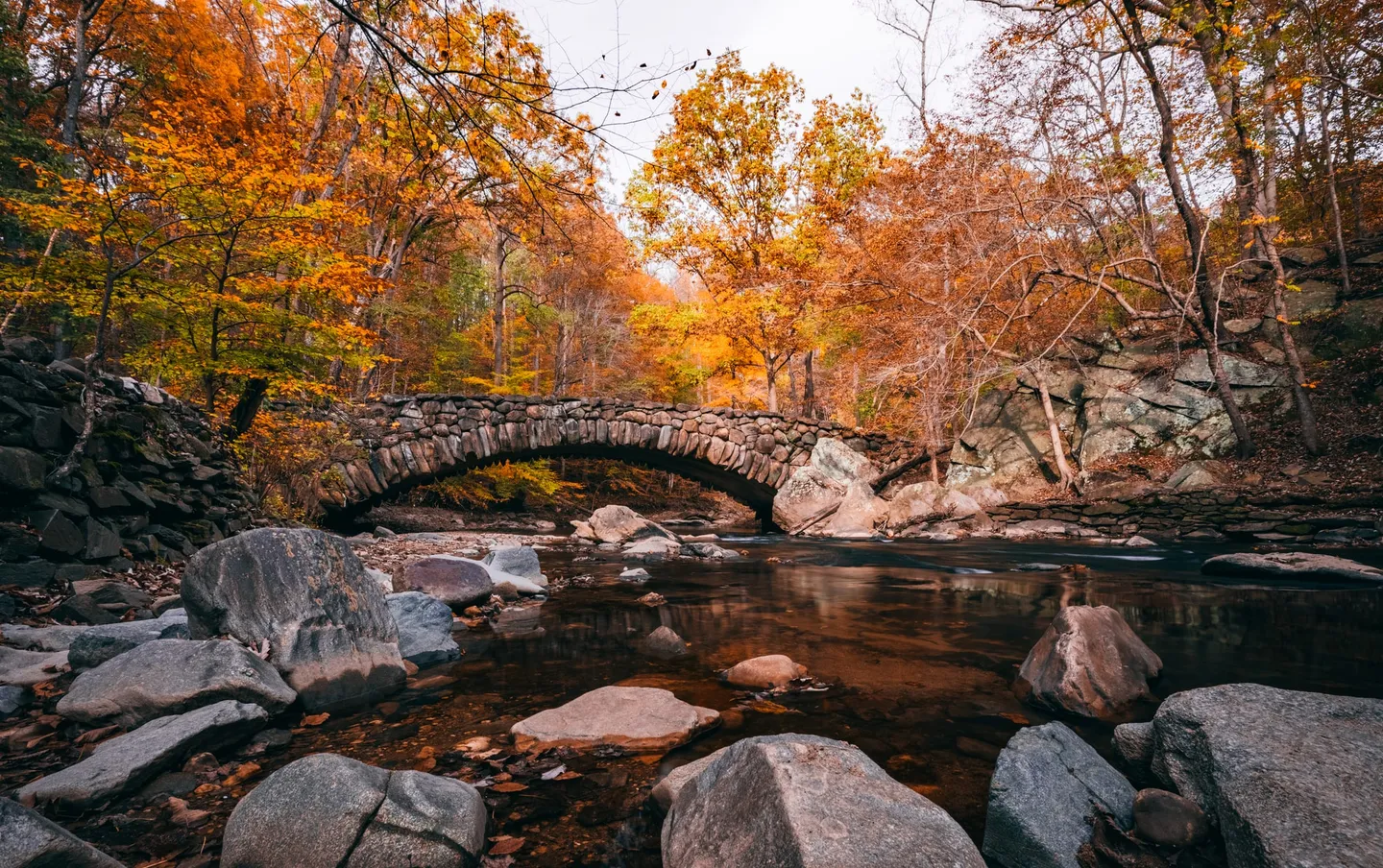
- Boulder Bridge, Rock Creek Park No change
Rock Creek Park · 71 ft · peaks Oct 22
A 1902 arch of unmortared fieldstone carrying Beach Drive over Rock Creek, sunk in a tulip poplar and beech ravine. Flat cloud keeps the boulders and the water dark, which is the only way the yellow canopy above them holds saturation.
- Theodore Roosevelt Island No change
Potomac River · 38 ft · peaks Oct 23
An 88-acre wooded island in the Potomac with a boardwalk over tidal swamp along its southeast side. River fog sits in that marsh on calm mornings after a cold night, and the swamp maples there turn ahead of anything on the mainland.
- Tidal Basin No change
National Mall · 10 ft · peaks Oct 23
The cherries that draw the April crowds go bronze and dull red in late October, a week or so behind Rock Creek. From the northwest bank the Jefferson Memorial sits across the water at 157 degrees, so first light rakes the far shore while the near trees stay in shadow.
- U.S. National Arboretum No change
Northeast DC · 53 ft · peaks Oct 23
The 446-acre arboretum includes Japanese maples in the Asian Collections. For a wider frame, the Capitol Columns place 22 sandstone columns in an open meadow.
Recent reports from Washington, D.C.
Report what you sawCommon questions
- When do the leaves change in Washington, D.C.?
- Washington, D.C. typically peaks Oct 18 – Oct 26, centered on Oct 22. Rock Creek turns through the last two weeks of October; the street trees and the Tidal Basin run several days behind it, and the willow oaks hold into November. These are typical dates from a latitude and elevation model; current conditions may differ.
- Where are the best places to see fall color in Washington, D.C.?
- The guide includes 4 researched locations in Washington, D.C., including Boulder Bridge, Rock Creek Park, Theodore Roosevelt Island, Tidal Basin. Boulder Bridge, Rock Creek Park turns first, around Oct 22, and U.S. National Arboretum is last, around Oct 23. Each includes coordinates, elevation and sunrise light times.
- What trees turn color in Washington, D.C.?
- Mainly tulip poplar, red oak, red maple, ginkgo. Yellows and oranges come from carotenoids that are already in the leaf, so they show up every year. Reds are made fresh each autumn and need warm sunny days with cool, frost-free nights, which is why a dry summer or a warm September produces a duller year.