Vermont Fall Foliage 2026
In a typical season, Vermont’s peak falls around October 5, with the broader window running October 1–9. High ground near 4,400 feet typically peaks around September 23, while 900-foot valleys peak around October 6. The Northeast Kingdom turns roughly a week before southern valleys, and ridgelines lead valley floors by 10–14 days.
Seasonal model estimate. Timing remains uncertain; check recent reports before traveling. Source: seasonal timing model. Calculated .
When Vermont peaks
Oct 1 – Oct 9
Centered on Oct 5. The Northeast Kingdom turns roughly a week before the southern valleys; ridgelines lead the valley floors by 10–14 days.
moderate confidence. A few weeks out. Expect this to move by several days.
Where peak usually lands. Drought or an early freeze moves it by a few days. Method
What turns here
- sugar maple
- red maple
- white birch
- beech
Yellows show up every year. Reds need sunny days and cool, frost-free nights. A bad year takes those first.
Color progression
Typical peak Oct 5Typical color progression for Vermont. No change from Aug 28 to Sep 14. First color from Sep 14 to Sep 23. Approaching peak from Sep 23 to Oct 1. Peak from Oct 1 to Oct 9. Past peak from Oct 9 to Oct 19. Bare from Oct 19 to Nov 2.
Vermont is typically at first color on this date.
Vermont by county
7 days from Essex County to Addison County.
Tap a location marker for coordinates and light times. Where peak usually lands. Boundaries: US Census, 2023. Elevation: USGS 3DEP + SRTM. Method
A county is still an average. Bennington County spans 7 days on its own, ridge to valley.
Every county, as text
| County | Typical peak | Stage today | Median elev. | Spread |
|---|---|---|---|---|
| Addison County | Oct 5 – Oct 13 | No change | 400 ft | 5 days |
| Bennington County | Oct 2 – Oct 10 | First color | 1,790 ft | 7 days |
| Caledonia County | Sep 30 – Oct 8 | First color | 1,272 ft | 4 days |
| Chittenden County | Oct 3 – Oct 11 | First color | 403 ft | 4 days |
| Essex County | Sep 28 – Oct 6 | First color | 1,679 ft | 2 days |
| Franklin County | Oct 2 – Oct 10 | First color | 491 ft | 4 days |
| Grand Isle County | Oct 4 – Oct 12 | First color | 99 ft | 0 days |
| Lamoille County | Sep 30 – Oct 8 | First color | 1,202 ft | 4 days |
| Orange County | Oct 2 – Oct 10 | First color | 1,152 ft | 3 days |
| Orleans County | Sep 29 – Oct 7 | First color | 1,297 ft | 2 days |
| Rutland County | Oct 4 – Oct 12 | First color | 856 ft | 6 days |
| Washington County | Sep 30 – Oct 8 | First color | 1,417 ft | 3 days |
| Windham County | Oct 4 – Oct 12 | First color | 1,242 ft | 4 days |
| Windsor County | Oct 3 – Oct 11 | First color | 1,188 ft | 3 days |
Peak by elevation
13 days between the ridges and the valleys below them. The county map above averages that away.
| Elevation band | Approx. elevation | Typical peak | Today |
|---|---|---|---|
| High ridges & passes | 4,400 ft | Sep 23 | Approaching peak |
| Mid elevation | 1,200 ft | Oct 5 | First color |
| Valleys & lowlands | 900 ft | Oct 6 | First color |
Foliage stages
- No change 0–10%
- First color 10–25%
- Approaching peak 25–60%
- Peak 60–90%
- Past peak 40–70%, dropping
- Bare <20%
Light at peak
Vermont on October 5, the center of its typical peak window.
| Event | Time |
|---|---|
| First light (blue hour) Sun 6° below horizon | 6:24 AM |
| Sunrise Rises E · 96° | 6:53 AM |
| Morning golden hour ends 39 min of low, warm light | 7:32 AM |
| Solar noon Highest sun, flattest light | 12:39 PM |
| Evening golden hour starts 39 min before sunset | 5:46 PM |
| Sunset Sets W · 264° | 6:25 PM |
| Last light (blue hour) Sun 6° below horizon | 6:54 PM |
Times in America/New York · day length 11h 32m · computed from NOAA solar equations
Which way to point the camera
Sun rises E, sets W.
Aim within 45° of those and the canopy glows translucent. Turn your back to them for flat, accurate color.
Location pages name the light directly.
Where to shoot in Vermont
6 researched locations, earliest peak first.
- Smugglers Notch First color
Mount Mansfield & Stowe · 2,123 ft · peaks Oct 1
VT Route 108 squeezes between the cliffs of Mount Mansfield and Spruce Peak, passing car-sized boulders that fell into the roadway. Birch and maple grow straight out of the talus, so color sits directly against wet gray rock.
- Lake Willoughby North Beach First color
Northeast Kingdom · 1,169 ft · peaks Oct 4
From the north beach the lake runs four miles south into the gap between Mount Pisgah and Mount Hor, whose cliffs drop straight into the water. Hardwoods on both walls turn while the spruce above them stays dark, so the ridges read as bands.
- Jenne Farm First color
Woodstock & Reading · 1,427 ft · peaks Oct 6
Red barns and a white farmhouse sit on an open hillside with stone walls running through the pasture in front of them. The maple woods on the slope behind turn before the pasture edge does, which gives the frame two color layers.
- Moss Glen Falls First color
Mount Mansfield & Stowe · 934 ft · peaks Oct 6
Moss Glen Brook drops about 125 feet through a narrow slate gorge with birch and maple leaning over the rim from both sides. The walls stay shaded all day, so leaves read against dark wet rock instead of blown-out sky.
- Stowe Community Church First color
Mount Mansfield & Stowe · 716 ft · peaks Oct 6
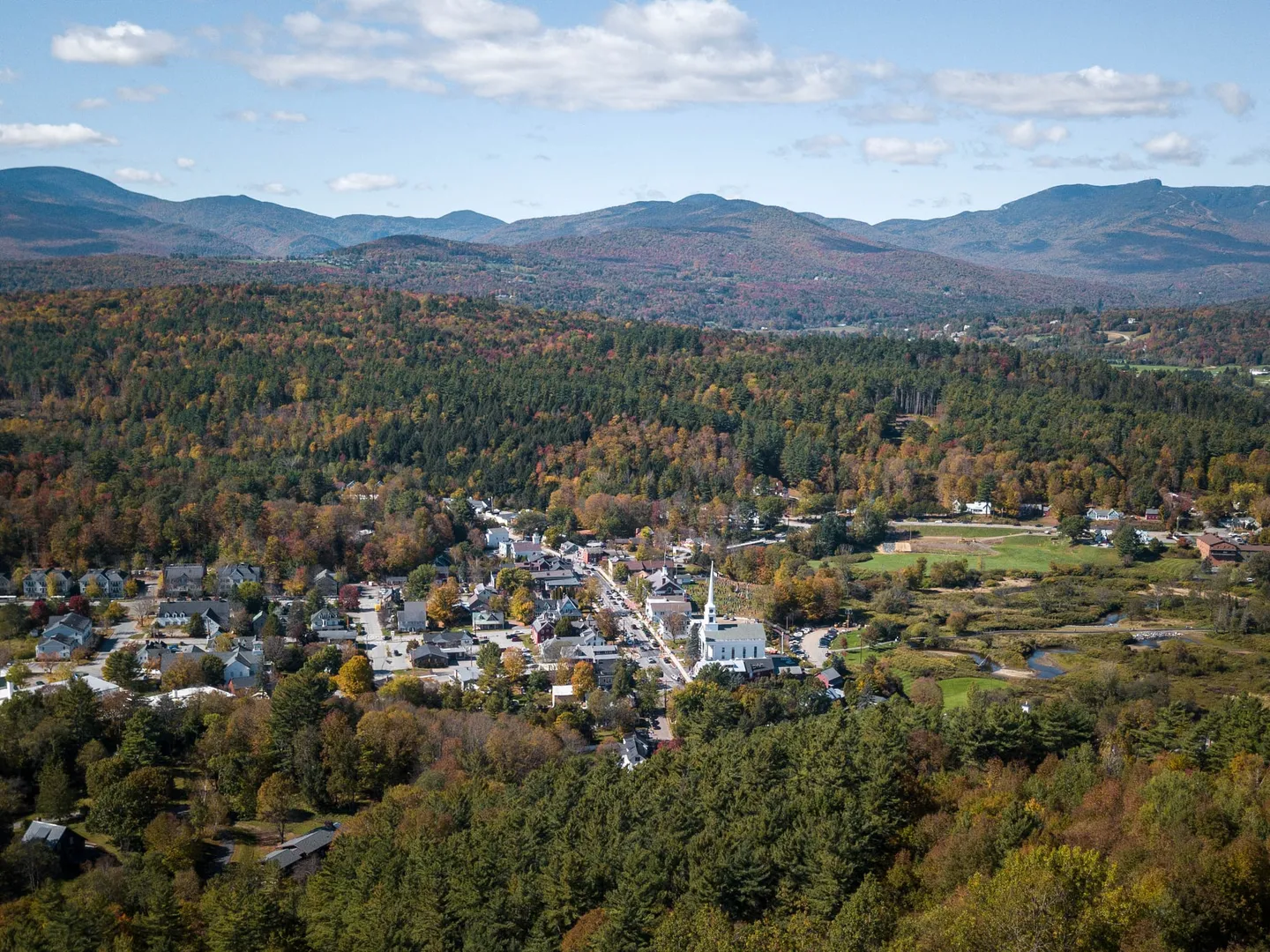
The white clapboard steeple closes the north end of Main Street with maples along both sidewalks and wooded hills rising behind the village. Shooting from the sidewalk a block south stacks the spire against colored slope.
- Sleepy Hollow Farm First color
Woodstock & Pomfret · 1,053 ft · peaks Oct 7
A white 1780s farmhouse and red barns sit in a hollow below Cloudland Road, with a curving drive lined by sugar maples dropping toward them. Morning fog pools in the bowl and separates the buildings from the wooded hillside behind.
Recent reports from Vermont
Report what you sawCommon questions
- When do the leaves change in Vermont?
- Vermont typically peaks Oct 1 – Oct 9, centered on Oct 5. The Northeast Kingdom turns roughly a week before the southern valleys; ridgelines lead the valley floors by 10–14 days. These are typical dates from a latitude and elevation model; current conditions may differ.
- Does elevation change when fall color peaks in Vermont?
- Yes, by about 13 days. High ground around 4,400 ft peaks near Sep 23, while valleys near 900 ft wait until Oct 6. Peak moves roughly 3.5 days earlier for every 1,000 feet you climb. Try lower valleys after high ground has passed peak, or higher ground while valleys are still green.
- Where are the best places to see fall color in Vermont?
- The guide includes 6 researched locations in Vermont, including Smugglers Notch, Lake Willoughby North Beach, Jenne Farm. Smugglers Notch turns first, around Oct 1, and Sleepy Hollow Farm is last, around Oct 7. Each includes coordinates, elevation and sunrise light times.
- What trees turn color in Vermont?
- Mainly sugar maple, red maple, white birch, beech. Yellows and oranges come from carotenoids that are already in the leaf, so they show up every year. Reds are made fresh each autumn and need warm sunny days with cool, frost-free nights, which is why a dry summer or a warm September produces a duller year.